Cooperative, Connected and Automated Mobility (CCAM)
CONNECTED MOBILITY
The future is Connected!
EMARC actively supports the research, development, and deployment of CCAM technologies to enable safer, cleaner, and more efficient transport systems. By integrating vehicle connectivity, automation, and intelligent infrastructure, CCAM revolutionizes how people and goods move.
Safe & Inclusive Mobility
Enhancing road safety through intelligent, user-centric solutions.
Data-Driven Transport
Leveraging real-time data and V2X communication for adaptive, cooperative mobility.
Sustainable Systems
Reducing congestion and emissions via automation and optimized fleet coordination.
Living Labs & Demos
Validating CCAM innovations in real-world conditions, including urban, suburban, and airport settings.
Autonomous FCEV and BEV bus
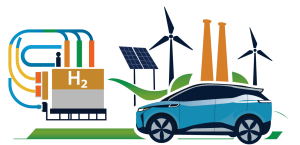
Level-4 Autonomous Hydrogen Fuel Cell & Battery Electric Bus
Building on its expertise in advanced green mobility, EMARC is spearheading the development of a cutting-edge, Level-4 ready autonomous bus within the framework of the Ro-Green project. This ambitious initiative focuses on integrating a hybrid powertrain that combines hydrogen fuel cell technology with a high-efficiency battery electric system, maximizing operational range and achieving entirely zero-emission urban transit. As a key research hub for the Technical University of Cluj-Napoca (TUCN), EMARC is responsible for the complete intelligent architecture of the vehicle. This includes the implementation of robust sensor fusion systems—utilizing high-density LiDAR, GNSS, and IMU tracking—alongside advanced automated driving algorithms capable of navigating complex urban environments without human intervention. By merging clean hydrogen energy with high-tier automation, EMARC and the RO-GREEN project are actively shaping the next generation of climate-neutral, intelligent public transportation systems.
Autonomous bus demonstrations
Autonomous Shuttle Demonstration at Cluj International Airport
As a cornerstone contribution to the European OLGA (hOListic Green Airport) project—a high-impact Horizon 2020 initiative led by Groupe ADP—EMARC successfully coordinated the entire autonomous bus demonstrator at the Avram Iancu Cluj International Airport. The OLGA project unites 57 prominent partners, including major European hubs like Paris-CDG, Milan Malpensa, and Zagreb, with the unified goal of accelerating aviation decarbonization and transforming airports into smart, sustainable, and low-carbon multimodal hubs.
Within this framework, EMARC spearheaded the Technical University of Cluj-Napoca’s (TUCN) operational efforts, managing the deployment from simulation and requirement analysis to real-world deployment. The pilot successfully integrated a Level-4 autonomous electric shuttle operating within a highly secure and dynamic airport environment. Utilizing advanced sensor fusion technologies—combining LiDAR point cloud processing, GNSS, and inertial measurement data—the system validated high-definition mapping and automated path planning under challenging real-world conditions.
By delivering a successful zero-emission transport solution, EMARC and TUCN have provided a scalable, replicable blueprint for smart airport logistics. This demonstration directly supports the aviation sector’s transition toward climate neutrality, showcasing how intelligent transportation systems can seamlessly enhance efficiency and lower emissions in specialized transport hubs across Europe.
Autonomous Bus Demonstration for Municipalities
EMARC actively supported the deployment and successful demonstrations of the Level-4 autonomous electric bus, the Karsan Autonomous e-ATAK, in Cluj-Napoca, Alba Iulia, and Bistrița. These pilot implementations validated the technology’s ability to safely navigate complex urban routes, including busy intersections and roundabouts, using advanced sensor and high-precision positioning systems.
Our contribution in applied research and technical expertise was crucial for preparing and testing the vehicle under specific Romanian conditions, thus laying the essential groundwork for the future integration of safe, smart, and sustainable autonomous public transport systems nationwide.
Scientific research and publications
Our commitment to advancing sustainable and intelligent mobility is underpinned by rigorous scientific inquiry. The publications listed below showcase our key peer-reviewed research and technical contributions, detailing the methodologies and findings from our applied work. Our research actively contributes to the global body of knowledge, driving innovation and shaping the next generation of smart public transport solutions, particularly in the areas of: Autonomous Vehicles and Technology Trends, Modular Autonomous Vehicles in Public Transport, Energy Efficiency and Electric Bus Optimization.
Stakeholders and Partners

Join us in shaping tomorrow's mobility
Connected, automated, and human-centered.
 English
  Romanian